
Southampton Resident Lookup Sources
Official records answer narrow questions. The assessment roll can show the printed last reputed owner, mailing field, situs, tax-map identifier, and roll year. A court index can show a case entry, while a vital-record request can answer an older family-history question only if the custodian's eligibility rules are met. Treat the source date as part of every match. A mailing address, an old deed, or a case caption is not proof of present residence.
| Record | What It Can Confirm | Custodian or Route | Access |
|---|---|---|---|
| Assessment and tax record | Printed owner/name, mailing and situs fields, tax map, values, and roll year | Southampton Assessor and Town roll | Public roll and map routes; field meanings differ |
| Voter lookup | Returned registration, polling, or mail-ballot information | New York voter lookup | Name, date of birth, county, and ZIP route; protected fields excluded |
| Court index | Party spelling, case identifier, and displayed case detail | WebCivil Local or responsible clerk | Portal coverage varies; a docket is not a certified result |
| Vital record | Historic birth, death, or marriage event when release rules permit | Southampton Town Clerk or village clerk | Application, proof, and fee rules apply |
| Historical record | Older family, address, newspaper, or map lead | Rogers Memorial Library and local archives | Catalog, reference room, appointment, or request |
Start with the most reliable fact already in hand. A full name and a dated address may fit the assessment roll or County Clerk index. A case number belongs with the court, and an old event belongs with the local registrar or a genealogy route. When a result has only a name, record the spelling and date but do not join it to a similarly named person.
Match Names in Southampton Records
A useful name match has more than a ZIP code. Compare name variants, middle initials, a relative or spouse reference where the official record displays one, the record date, and a shared identifier such as a tax map, case number, entity number, or license number. Southampton's Town and incorporated-village boundaries also matter. A record held by a village clerk can follow a different route from one held by the Town Clerk.
The assessment record should be read in its own terms. Its owner/name of last reputed owner, mailing field, and physical situs can be different fields. The Suffolk County Clerk's recorded document is the route for a deed trail, and its online land-record coverage is stated as 1987 to the present. An older historical lead may instead need a library, museum, archive, or clerk request.
WebCivil for Southampton Name Checks
Suffolk District Court's WebCivil Local instructions list searches by index number, party, attorney, judge, and calendar, court, judge, or part. The instructions state that local CV, CC, and SC cases filed since 2008 are available. LT cases remain online only until 14 days after the final appearance. Search a party name with spelling variants, then preserve the court's case type and identifier exactly as shown.
The captured WebCivil Local instructions are shown in the search reference below.
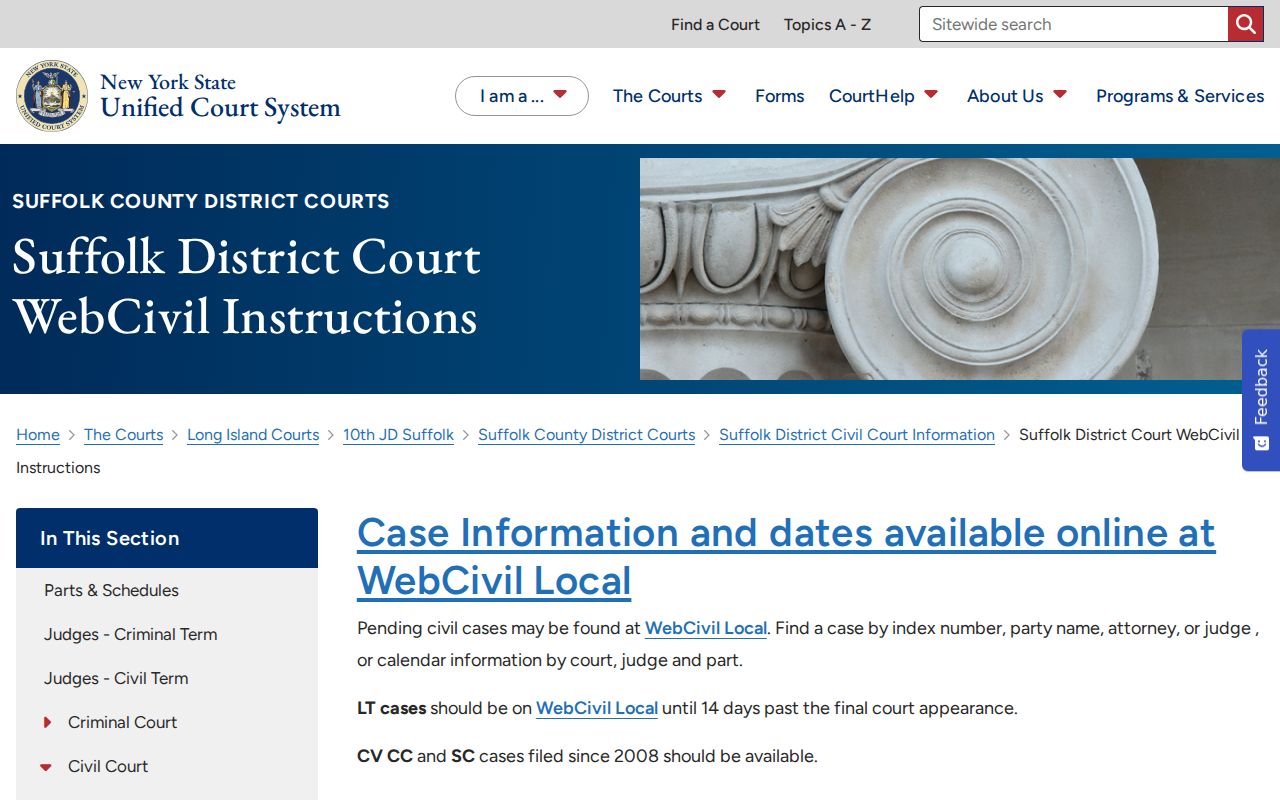
Those instructions help separate a searchable court index from a court-certified outcome, which must come from the appropriate clerk.
A returned screen can include a party name, index number, appearances, judge, or links where the court displays them. It does not settle identity on its own. Sealed and sensitive material may be limited, and a case listing should not be expanded into a claim about the people named in it.
Southampton Court Clerk Fallback
The Southampton Town Justice Court handles criminal, civil, traffic, and parking matters, but research found no public online name search for that court. For an appropriate record, contact the clerk to ask about the right request channel, availability, certification, and any copy procedure. A blank web search cannot establish that no Town Justice record exists.
For Suffolk Supreme matters, the court's directions use WebCivil Supreme index search with the Suffolk venue and a six-digit number/year format. Case Detail may show appearances, judge, and e-filed documents where displayed. The Suffolk e-filing information explains the court's electronic filing context, including stated implementation and exceptions.
The official Suffolk e-filing reference below helps distinguish a portal display from a certified court record.
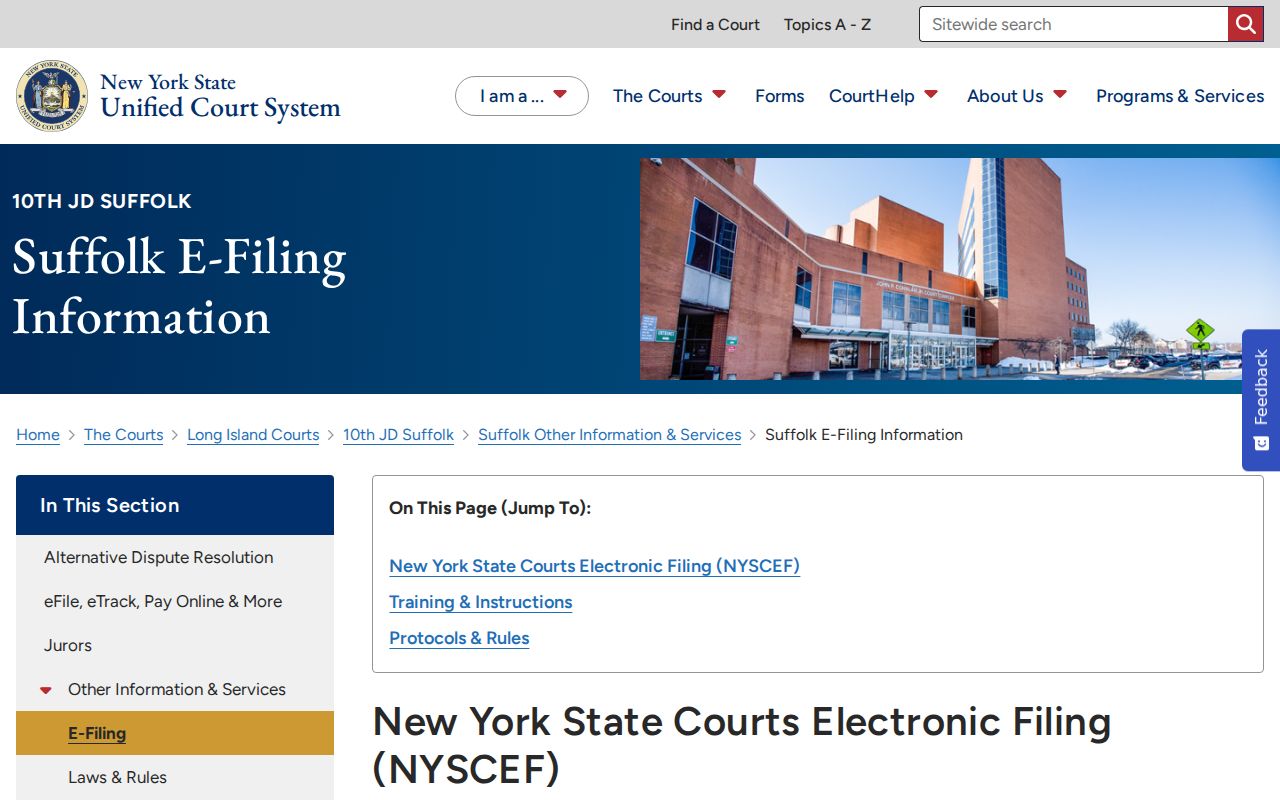
When the record matters for probate, a legal filing, or a correction, request the clerk's prescribed copy or certified disposition rather than relying on a screenshot.
Southampton Vital Record Eligibility
Vital records are not a general name-search tool. The Town Clerk issues qualifying birth, death, and marriage records for events outside the seven incorporated villages. Births and deaths at Southampton Hospital beginning in 1923 are directed to the Southampton Village Clerk. First establish the event location and the clerk that holds it.
For genealogy, Town rules state birth records become available after 75 years when the person is deceased, death records after 50 years, and marriage records after 50 years when both spouses are deceased. A direct-line descendant may use a waiver with relationship and death proof. The local route has its own application and fee schedule, while the New York State Department of Health has a separate statewide process. An index, an image, and a certified copy carry different evidentiary weight.
Voter Facts in a Resident Lookup
The official voter service takes County, last name, first name, date of birth, and ZIP information, and supports registration, polling-place, and mail-ballot functions. It is not a full voter-file download. A returned result should be treated as the service's current operational response, not as proof that a person is physically present at an address.
Election Law section 3-220 protects driver-license or non-driver-ID information, Social Security numbers, and facsimile numbers. New York State Board of Elections requests for information derived from voter registration use an elections-purpose route. A missing result can reflect spelling, a protected record, a changed status, or a different input, rather than a conclusion about someone.
Official DOCCS Status Checks
The official New York DOCCS inmate lookup accepts a DIN or a complete name and birthdate, then displays status or release information with a date of information. A DIN combines a two-digit year, a letter, and four digits. This is a limited state custody record, not a general resident roster and not a substitute for a court disposition.
The captured DOCCS lookup shows the official route used for this narrow status check.
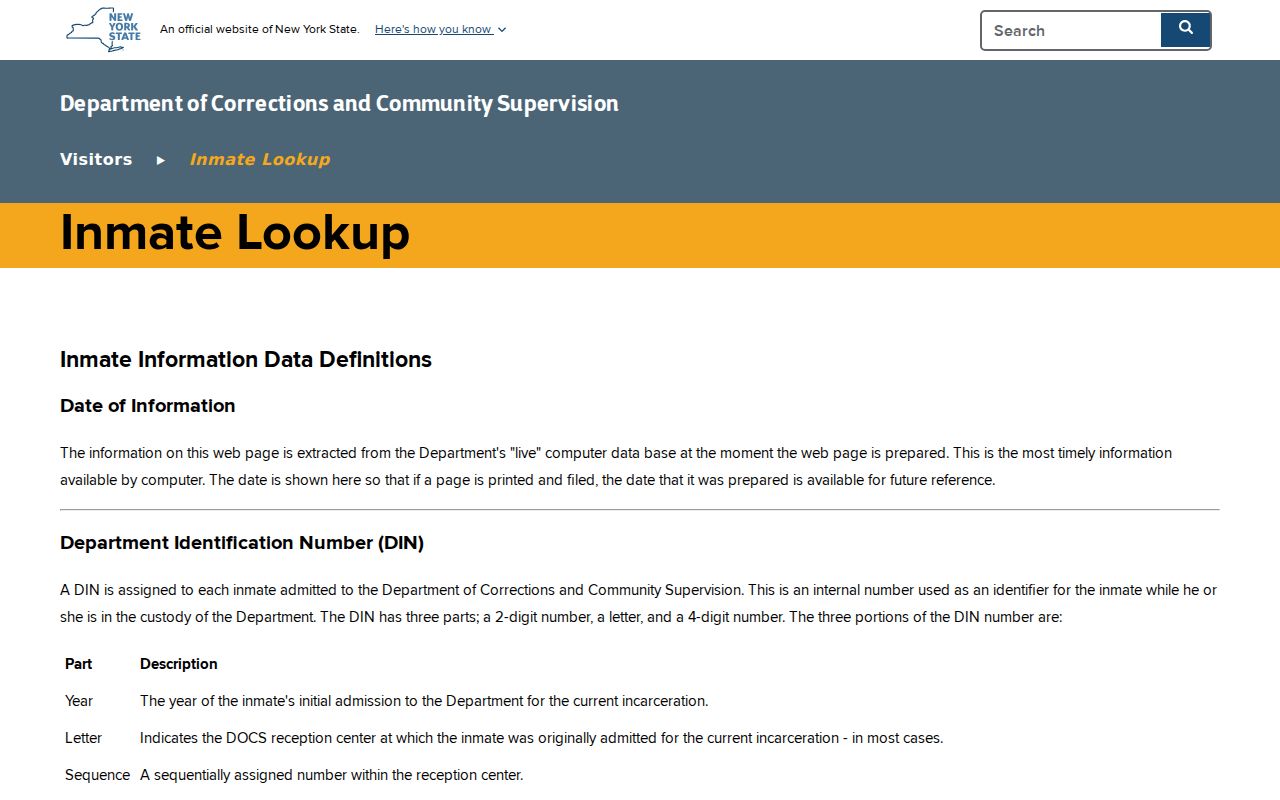
Use the result's date and the agency's stated fields, because a name-and-date-of-birth match still requires careful identity confirmation.
Verify a Southampton Record Trail
Use one dated fact to test the next source. This process keeps a resident lookup focused on records that actually fit the question, rather than collecting loosely related name hits.
- Record the supplied name, known date, and address context without assuming the address is current.
- Use the assessment roll, eTax, or a County Clerk tax-map route to identify the parcel and its year-specific fields.
- Search the appropriate court index or clerk route with the same spelling variants and preserve its case number and court.
- For an historic event, follow the Town, village, or state vital-record eligibility route and request a certified record only when the custodian permits it.
A result inventory makes later checking possible. An assessment row can show tax map, printed owner/name, mailing and situs fields, roll year, values, exemptions, class, and district codes. A Clerk kiosk deed result can show liber, page, document type, grantor, grantee, received date, notations, and image or certified-copy controls. Court and vital results should retain their own agency, date, identifier, and access status.
- Docket
- A court's running record of a case and its filings or events. It is not automatically a final certified disposition.
- Index and image
- An index points to a record by fields such as name, date, or identifier. An image is the displayed document itself, when the custodian makes one available.
- Certified copy
- A copy issued and authenticated by the responsible office for the purpose the office permits. Its request rules can differ from those for a public index.
For address-by-address context rather than one-person verification, use the Southampton street directory route to follow the separate parcel and document trail.
Southampton FOIL Record Requests
When a municipal record is not searchable online, make a focused request through the Town FOIL process. Give the full physical address, tax map or DSBL if known, relevant department, record type, and date range. For permits, site plans, or zoning decisions, include the project, decision number, board, meeting date, or time frame when known. That detail helps the office locate an existing record without creating a new analysis.
New York FOIL is Public Officers Law Article 6. The agency generally grants, denies, or acknowledges a request within five business days, and an appeal has its own stated timetable. Records can be redacted or withheld under an exemption. A missing response may point to a different custodian, village boundary, date range, sealed file, or incomplete portal coverage.
Note: Preserve the request date, agency acknowledgment, record date, and retrieval date so a later correction can be taken to the right custodian.
Southampton Resident Lookup Privacy Limits
New York FOIL does not override sealing, confidentiality, or other statutory protections. The Address Confidentiality Program gives eligible participants a substitute mailing address, and their actual location must not be reconstructed by combining records. Motor-vehicle information is also restricted under the Driver's Privacy Protection Act. Do not use a plate, VIN, or name-to-address request as a shortcut.
If a record appears wrong, save its exact identifier, source date, and field label, then contact the agency that maintains it. A Town roll, County Clerk index, voter file, court docket, and license listing each have a different correction route. Use the narrowest public source needed for family research, property or document questions, civic transparency, seller-scam verification, or personal safety.
Lawful use. Public records do not permit stalking, harassment, intimidation, or attempts to reveal a protected address. New York Penal Law sections 120.45 and 240.26 set important boundaries for repeated targeting conduct.